

Research suggests people experience many significant transitions across adult life—often a dozen-plus job changes and numerous major life events.
A good, concrete benchmark comes from the U.S. Bureau of Labor Statistics using the National Longitudinal Survey of Youth: People averaged 4.5 jobs between ages 25–34 and 2.9 jobs between ages 35–44.
That means: for many people, the 30s and early 40s include multiple job changes even before you count promotions, layoffs, role changes, or career pivots.
The best examples that come to mind particularly in terms of promotions, jobs changes and career pivots are Christine Lagarde and Arnold Schwarzenegger.
You would think that their names hardly belong in one sentence but they have a lot in common: both coming from different backgrounds they show us the kind of success one is able to achieve in many different and non-overlapping areas.
Arnold Schwarzenegger (born in Austria 1947) started his career in bodybuilding in Europe, moved to the US shaping the bodybuilding industry into the mainstream culture and winning Mr. Olympia title 7 times.
He transitioned from bodybuilding into film in the 1970s becoming the biggest box-office star in the world, known for True Lies, Predator and Terminator.
In the early 2000s he pivoted from film into politics winning the 2003 California recall election and becoming a governor. He was re-elected in 2006 and served till 2011.
Today he is an investor, entrepreneur and a public advocate around fitness and health, environment and community.
Christine Lagarde (born in France, Paris 1956) is a French lawyer who started her career at Baker McKenzie and became the first Global Chairman of the firm in 1999.
She entered the French government in 2005 as Minister for Foreign Trade, briefly served as Minister of Agriculture, and then became Minister of the Economy, Finance and Industry (2007–2011). She is widely noted as the first woman to serve as finance/economy minister of a G7 country.
She was selected as Managing Director of the International Monetary Fund in 2011 and served until 2019, overseeing major global economic challenges and policy negotiations.
She is currently a President of the European Central Bank, starting on 1 November 2019.
Christine Lagarde is widely recognized as the first woman to hold several of these roles (notably at the IMF and ECB, and as a G7 finance minister), which is rare not just individually but in combination.
We know that change and transitions (such as these) are possible and beneficial for our growth and life satisfaction, but why are they so hard?
First, some of it has to do with the loss of professional identity (Ibarra, 2023).
Your sense of identity is anchored in the well-defined groups and organisations with which you are associated and by which your are recognised. Without it, you can quickly start to feel lost, anxious and irrelevant.
Second, emotional ups and downs are to be expected in transition. You must navigate between a past that is over and a future that’s still uncertain, the so called liminal state and the main reason we don’t like change.
Third, you have to create your own steps for making progress because career changes aren’t predictable and linear anymore.
If you have been thinking about a big life decision such as career change here are some suggestions.
(1) Don’t wait to figure it all out before you start. This is especially important if you tend to overthink. No amount of thinking is a substitute for action.
(2) If you don’t know what you want, try seeing change as an iterative process. Explore your interest until something new becomes viable; if you need a license for a job that interests you, see how you can obtain it, if you need a certain course or studies to start new career, go and study.
(3) Next and equally important create new relationship beyond your current circle. New opportunities often arise from so called weak ties – people we don’t know well but are likely the ones that can help connect to new opportunities.
(4) Lastly, and really important, seek out and talk to people who have made change that you want to make. Find out what steps they had to take, what obstacles they faced and what helped them.
If you aspire to make a change in your career or life in general, there has to be a starting point, experimentation and connection to people that can help you. You don’t have to pivot to areas that rarely overlap like Lagarde or Schwarzenegger did but know that it is possible to make big changes. They are risky and scary but so is the status quo.
You can always start small and see where it takes you.
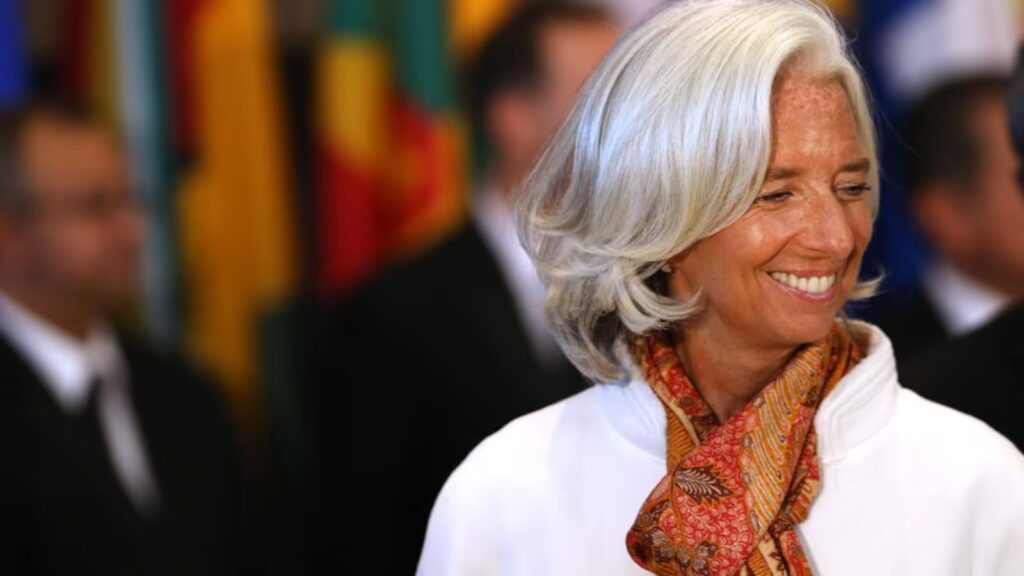
Image: Christine Lagarde, Getty Images 2011, The Irish Times.
Source:
Why Transition Is So Hard, Herminia Ibarra, Harvard Business Review, November-December 2023.